Showing posts with label Informatory. Show all posts

Thursday, April 26, 2012

My book on hacking A guide, A representation of todays condition of cyber lif3 of hackers

hi guys wassup i was a skid before but i left that path and went in the search of truth and knowledge. SQL injection is fun but then i realized that thats not true hacking and now i am changed....... Looking at the current condition of skids and new beginners i wrote a small book to start with. it does not contain any article,tutorial,or 0day exploits it contains real life and experiences that are experienced by young hackers it contains inspirational things that will help people a lot. hope you like it. my main motive was to direct young progressing hackers to a path that will lead to a good hacking carrier omg too much philosophy :P but its important too download

Monday, April 23, 2012

How to become d0x pr00f

hi friends after exams i am free now will write some posts. yesterday i saw 1 one of my friends exposing s3rverexe. and s3rverexe also tried to expose him but failed. so today i will give you some tips on not letting your identities exposed. so first never share any information on forums, dating sites. matrimonial websites, or not even Facebook as now Google indexes its posts and comments. and be aware of adding unknown friend in your real account and never put a connection between your real and fake account. mostly if you are in INDIA you don't need to worry much as there are not any public records. but for countries like USA there are sites which have many information about you by credit-card etc.
Only hiding everything is not fun always. sometimes even misdirection also makes fun.
real life example. i tired to get information about coded32 i googled his name i got his threads and in one thread i saw that he posted his university results then i thought that there was someone of similar profile on facebook. he had chosen a person similar to his behavior,living place(old ), and university. that was a type of misdirection
so you can also try it on others and secure your identity online. this becomes important after passing of CISPA.
stay saFE.

Saturday, April 7, 2012

Introduction to SCADA hacking

hi guys wassup today i will tell you about SCADA hacking some other reosurces 

so first what is SCADA ? its abbreviated as Supervisory Control and Data Acquisition so basically there are lots of hardwares in it ans used in power grids, Dams and many other industires. they use primitive softwares that are easy to exploit. remember Stuxnet that exploited Iran`s windows computer to exploit iran`s nuclear facility which was of Siemens. same way there are lots of companies who make SCADA and for ease of use and to control them from remote places they have internet connection
so basically there are PLC (programmable logic contoller) which are exploited mostly. the I/O cycles are controlled by RISC (Reduced instruction set computing) processor

PLCs use RISC processors to run continuous, cyclical programs and they take time in their I/O cycle to talk to the SCADA unit and receive instructions from the SCADA to modify its instruction sets or operating parameters. SCADA typically operates by evaluating the input data and determine if it is within an allowable set of parameters

1st how to find vulnerable SCADA devices
you must know what an HTTP header does and also that we can know that what software or authentication a server is running. with the use of that we will find vulnerable SCADA devices. A website called Shodanhq does and makes our work easy
from that a specific code(something like dorks) we can get lots of SCADA

2nd exploits
SCADA exploits are hard to get  coz no one shares that sometimes you need to make your own but you can get some from exploit Db or there is are modules by metasploit to exploit some of them are here or here 

RESOURCES
1. shodanhq.com
2. scadahacker.com
3. SCADA dorks list 
4.SCADA security research and tools 

warning SCADA hacking is a very very  dangerous it can get people killed and lot of property damage... and end up in your life in jail for longer time and
this article is for education purposes only

Monday, February 6, 2012

Acess your google chrome hidden power

HI guys this links reveal many things about your system configs,it can also track usages, and also any things try it List of Chrome URLs chrome://appcache-internals chrome://blob-internals chrome://bookmarks chrome://cache chrome://chrome-urls chrome://crashes chrome://credits chrome://dns chrome://downloads chrome://extensions chrome://flags chrome://flash chrome://gpu-internals chrome://histograms chrome://history chrome://ipc chrome://media-internals chrome://memory chrome://net-internals chrome://view-http-cache chrome://newtab chrome://plugins chrome://print chrome://quota-internals chrome://sessions chrome://settings chrome://stats chrome://sync-internals chrome://tcmalloc chrome://terms chrome://tracing chrome://version chrome://workers chrome://linux-proxy-config chrome://sandbox For Debug The following pages are for debugging purposes only. Because they crash or hang the renderer, they're not linked directly; you can type them into the address bar if you need them. chrome://crash/ chrome://kill/ chrome://hang/ chrome://shorthang/ chrome://gpuclean chrome://gpucrash chrome://gpuhang Any problems ask in comments

Friday, January 27, 2012

welcome back,the L33t

hi guys you must have been to my new wp blog but it wasnt fun, really nothing is better than blogger agree??
ok this time we have an open source app which can hide data within password and its also a text editor
heres what the developer SAYS


Steganos LockNote will change the way you work with confidential notes. Application and document in one: the mechanism to encrypt and decrypt a note is part of it. Secure, simple, independent. No installation required.
System requirements: Windows 2000, Windows XP, Windows Vista, Windows 7

Why use Steganos LockNote?

  • Store your most valuable notes as a LockNote
    Hide your serial numbers, passwords, phone numbers and everyday notes in a safe place. Your informations will be encrypted using a password and most modern AES 256bit encryption technology.
  • Secure, yet simple
    Just double-click a LockNote and enter your password to access your text files as usual.
  • No installation required
    Move LockNotes wherever you want, as often as you want. A LockNote document does not require much more hard drive space than an unencrypted document.
  • Encrypt existing text files in no time at all
    Simply drag and drop existing text files on a LockNote window: they will be encrypted automatically.
  • Open and free
    LockNote is open source and is based upon open source technologies, e.g. the certified CryptoPP program library for strong encryption.
the app is just fun and easy to use and its only a single EXE file so just download it from here 

Saturday, December 17, 2011

Create your own facebook App for pages

hi guys today there are lots of good things going on we have 10,000 pageviews and we have a new friend blackbox. and today is my birthday. :))
So how to get that coool apps that we see on big companies pages for FREE here is the solution

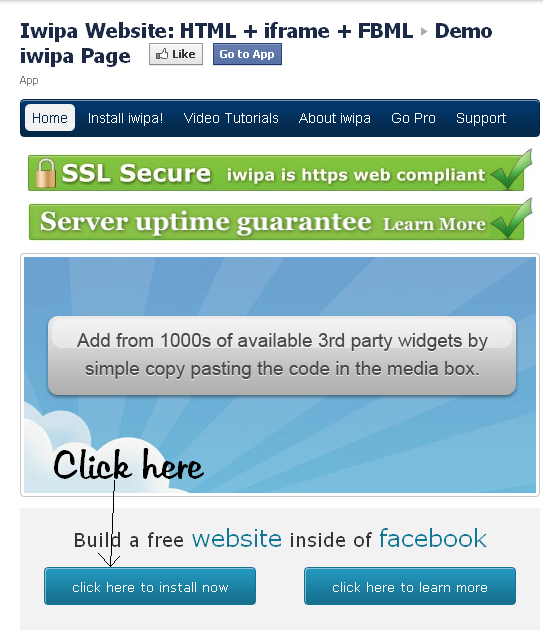
1st Goto iwipa app page =>>from here 

2nd select click here to install it at the bottom of page then when page reloads click on same type of button I.E. click here to install it for free.

3rd then it will take to a page where you can select your page after selection of page let it reload and then click.
Add Iwipa Website:HTML+Iframe+FBML  
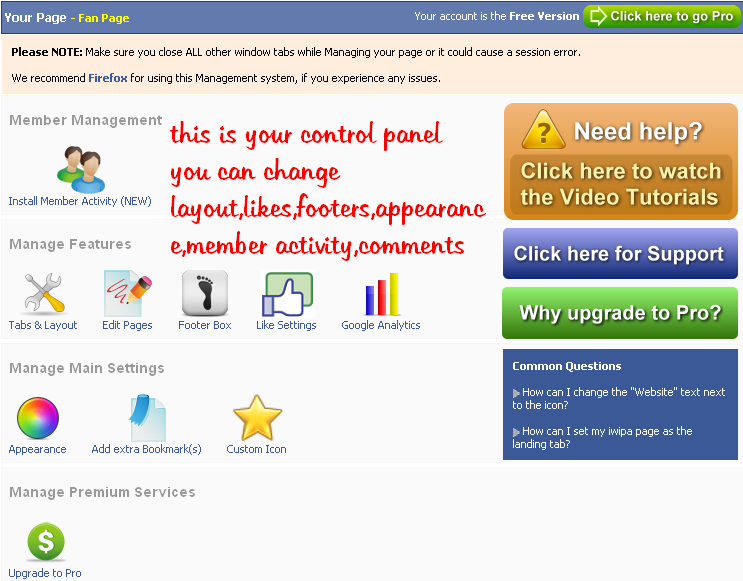
4th then follow screen shots and now get your own app for your own page play around with it, its a good utility for those who dont know coding and other things.
here is my page app check it out =>>go here
and YOU have members, comments,etc lots of other features

screenshots


Any problems ask in comments

Friday, October 21, 2011

EVERYTHING that you should know while learning hacking

hello guys today i will tell you some things that you should know when you are hacking this will help you in increasing your technical knowledge. and will clear your doubts about it 
  1. there is no software that can hack facebook passwords (except key logging and phishing) same with e-mail account hacking 
  2. kernel is the main component of most computer operating systems; it is a bridge between applications and the actual data processing done at the hardware level. The kernel's responsibilities include managing the system's resources (the communication betweenhardware and software components). Usually as a basic component of an operating system, a kernel can provide the lowest-level abstraction layer for the resources (especially processors and I/O devices) that application software must control to perform its function. It typically makes these facilities available to application processes through inter-process communication mechanisms and system calls.
  3. Linux is a computer operating system which is based on free and open source software. Although many different varieties of Linux exist, all are Unix-like and based on the Linux kernel, an operating system kernel.
  4. An exploit (from the verb to exploit, in the meaning of using something to one’s own advantage) is a piece of software, a chunk of data, or sequence of commands that takes advantage of a bug, glitch or vulnerability in order to cause unintended or unanticipated behavior to occur on computer software, hardware, or something electronic (usually computerised). This frequently includes such things as gaining control of a computer system
  5. A shell is a piece of software that provides an interface for users of an operating system which provides access to the services of a kernel. However, the term is also applied very loosely to applications and may include any software that is "built around" a particular component, such as web browsers and email clients that are "shells" for HTML rendering engines. The name shell originates from shells being an outer layer of interface between the user and the internals of the operating system (the kernel)
  6. PHP is a general-purpose server-side scripting language originally designed for web development to produce dynamic web pages. For this purpose, PHP code is embedded into the HTML source document and interpreted by a web server with a PHP processor module, which generates the web page document. It also has evolved to include a command-line interface capability and can be used in standalonegraphical applications.
  7. jQuery is a cross-browser JavaScript library designed to simplify the client-side scripting of HTML. It was released in January 2006 at BarCamp NYC by John Resig. Used by over 49% of the 10,000 most visited websites, jQuery is the most popular JavaScript library in use today
  8. A network host is a computer connected to a computer network. A network host may offer information resources, services, and applications to users or other nodes on the network. A network host is a network node that is assigned a network layer host address.
  9. In mathematics and computer science an algorithmis an effective method expressed as a finite list of well-defined instructions for calculating a function Algorithms are used for calculation, data processing, and automated reasoning. In simple words an algorithm is a step-by-step procedure for calculations.
  10. there are many websites that can be searched for vulnerablities and can be hacked but if you are a real hacker then you should select the website and then try to hack it 
  11. A router is a device that forwards data packets between computer networks, creating an overlay internetwork. A router is connected to two or more data lines from different networks. When data comes in on one of the lines, the router reads the address information in the packet to determine its ultimate destination. Then, using information in its routing table or routing policy, it directs the packet to the next network on its journey. Routers perform the "traffic directing" functions on the Internet. A data packet is typically forwarded from one router to another through the networks that constitute the internetwork until it gets to its destination node
  12. In computer networks, a proxy server is a server (a computer system or an application) that acts as an intermediary for requests from clients seeking resources from other servers.
  13. BB5 unlocking in Nokia phones is not possible to install unsigned OS in Nokia (not simlock).
  14. The Metasploit Project is an open-source computer security project which provides information about security vulnerabilities and aids in penetration testing and IDS signature development. Its most well-known sub-project is the Metasploit Framework, a tool for developing and executing exploit code against a remote target machine. Other important sub-projects include the Opcode Database,shell code archive, and security research. 
  15. there is not a method to decrypt nokia MCUSW file and change it because if we do it then the check sum is changed than that of phone and its not installed 
  16. Symbian can be hacked by using ROM patcher and hellox 
  17. Free hosting websites don't allow to use rapid leech script and other forums.
  18. Unix (officially trademarked as UNIX, sometimes also written as Unix) is a multitasking, multi-user computer operating system originally developed in 1969 by a group of AT&T employees at Bell Labs, including Ken Thompson, Dennis Ritchie, Brian Kernighan, Douglas McIlroy, and Joe Ossanna. The Unix operating system was first developed in assembly language.
  19. A scripting language, script language, or extension language is a programming language that allows control of one or more applications. "Scripts" are distinct from the core code of the application, as they are usually written in a different language and are often created or at least modified by the end-user. Scripts are often interpreted from source code or bytecode 
  20. Cross-site scripting (XSS) is a type of computer security vulnerability typically found in Web applications that enables attackers to inject client-side script into Web pages viewed by other users. A cross-site scripting vulnerability may be used by attackers to bypass access controls such as the same origin policy.
  21. A denial-of-service attack (DoS attack) or distributed denial-of-service attack (DDoS attack) is an attempt to make a computer resource unavailable to its intended users. Although the means to carry out, motives for, and targets of a DoS attack may vary, it generally consists of the concerted efforts of a person, or multiple people to prevent an Internet site or service from functioning efficiently or at all, temporarily or indefinitely
  22. Getting access to router doesn't provide you access to network 
  23. A Media Access Control address (MAC address) is a unique identifier assigned to network interfaces for communications on the physical network segment. MAC addresses are used for numerous network technologies and most IEEE 802 network technologies including Ethernet. Logically, MAC addresses are used in the Media Access Control protocol sub-layer of the OSI reference model.
  24. Ankit fadias seminars are crap and its courses too.
  25. Social engineering is the art of manipulating people into performing actions or divulging confidential information. While similar to a confidence trick or simple fraud, the term typically applies to trickery or deception for the purpose of information gathering, fraud, or computer system access; in most cases the attacker never comes face-to-face with the victim.
  26. Rooting is a process that allows users of mobile phones and other devices running the Android operating system to attain privileged control (known as "root access") within Android's Linux subsystem with the goal of overcoming limitations that carriers and manufacturers put on some devices. It is analogous to jailbreaking on devices running the Apple iOS operating system.
  27. Tethering means sharing the Internet connection of an Internet-capable mobile phone with other devices. This sharing can be offered over a wireless LAN (Wi-Fi), or over Bluetooth, or by physical connection using a cable. In the case of tethering over wireless LAN, the feature may be branded as a mobile hotspot. The Internet-connected mobile phone acts as a portable router when providing tethering services to others
  28. Malware, short for malicious software, consists of programming (code, scripts, active content, and other software) designed to disrupt or deny operation, gather information that leads to loss of privacy or exploitation, gain unauthorized access to system resources, and other abusive behavior.The expression is a general term used by computer professionals to mean a variety of forms of hostile, intrusive, or annoying software or program code
  29. a honeypot is a trap set to detect, deflect, or in some manner counteract attempts at unauthorized use of information systems. Generally it consists of a computer, data, or a network site that appears to be part of a network, but is actually isolated and monitored, and which seems to contain information or a resource of value to attackers
  30. A cache is a component that transparently stores data so that future requests for that data can be served faster. The data that is stored within a cache might be values that have been computed earlier or duplicates of original values that are stored elsewhere. If requested data is contained in the cache (cache hit), this request can be served by simply reading the cache, which is comparatively faster. Otherwise (cache miss), the data has to be recomputed or fetched from its original storage location, which is comparatively slower. Hence, the more requests can be served from the cache the faster the overall system performance.
  31. A Trojan horse, or Trojan, is software that appears to perform a desirable function for the user prior to run or install, but (perhaps in addition to the expected function) steals information or harms the system. The term is derived from the Trojan Horse story in Greek mythology.
  32. Overclocking is the process of operating a computer component at a higher clock rate (more clock cycles per second) than it was designed for or was specified by the manufacturer.
  33. The MD5 Message-Digest Algorithm is a widely used cryptographic hash function that produces a 128-bit (16-byte) hash value., MD5 has been employed in a wide variety of security applications, and is also commonly used to check data integrity
  34. An assembly language is a low-level programming language for computers, microprocessors, microcontrollers, and other programmable devices. It implements a symbolic representation of the machine codes and other constants needed to program a given CPU architecture.
  35. A hash function is any algorithm or subroutine that maps large data sets to smaller data sets, called keys. For example, a single integer can serve as an index to an array (associative array). The values returned by a hash function are called hash values, hash codes,hash sums, checksums or simply hashes.
  36. In computer security and programming, a buffer overflow, or buffer overrun, is an anomaly where a program, while writing data to a buffer, overruns the buffer's boundary and overwrites adjacent memory. This is a special case of violation of memory safety.
  37. Buffer overflows can be triggered by inputs that are designed to execute code, or alter the way the program operates. This may result in erratic program behavior, including memory access errors, incorrect results, a crash, or a breach of system security. They are thus the basis of many software vulnerabilities and can be maliciously exploited.
  38. Remote File Inclusion (RFI) is a type of vulnerability most often found on websites. It allows an attacker to include a remote file, usually through a script on the web server. The vulnerability occurs due to the use of user-supplied input without proper validation. This can lead to something as minimal as outputting the contents of the file, but depending on the severity, .
  39. SQL often referred to as Structured Query Language is a programming language designed for managing data in relational database management systems (RDBMS). Originally based upon relational algebra and tuple relational calculus, its scope includes data insert, query, update and delete, schema creation and modification, and data access control.SQL injection or SQLi is a code injection technique that exploits a security vulnerability in some computer software. An injection occurs at the database level of an application (like queries). The vulnerability is present when user input is either incorrectly filtered for string literal escape characters embedded in SQL statements or user input is not strongly typed and unexpectedly executed. Using well designed query language interpreters can prevent SQL injections.                                                                                        I will keep this page updated with more information


    Sunday, September 25, 2011

    Information Gathering Techniques and Tools


    What is information gathering??
    Whenever planning an attack it is the is most sole part of it if you fail here then you can’t perform a successful attack on your victim.

    what is OS fingerprinting???
     TCP/IP stack fingerprinting is the passive collection of configuration attributes from a remote device during standard layer 4 network communications. The combination of parameters may then be used to infer the remote machine's operating system (aka, OS fingerprinting), or incorporated into a device fingerprint.

    IP addresses are the most useful here but what are IP addresses these are the identity of your systems    presence on internet and it is used for communication purposes. 
    # Dynamic IP- these are the free ones provided by your ISP and change automatically at anytime day or night.

    # Static IP- these are the paid ones used by the MNC and other big companies for remote communication 
    and it’s easy to hack this one’s rather than dynamic ones……

    # How to get IP of any nodes connected to internet
    The best way is pinging or we can say establishing connection with the node its easy to perform just go to command type ping www.example.com  and if the host is alive on internet then it will reply and you will get its IP addresses.

    # The second method by which you can find an IP of an victim by doing an whois search of the server or of the website name go to google.com type whois  www.example.com you will get the  all information about your victim and many other useful things 

    2. PORT scanning
    After you are confirmed with the IP of victim  you can proceed with this step.
    There are many ports though which you communicate with internet like FTP for transfer of files HTTP for surfing websites , IMAP POP for emails etc.

    # TOOLS for port scanning, OS finger printing, IP hosts, 
    2) MingSweeper is a network reconnaissance tool designed to facilitate large address space,high speed node discovery and identification. MingSweeper is capable of performing Ping sweeps, Reverse DNS sweeps, TCP & UDP port scans, OS identification and application identification.

    # Features of mingsweeper
    1.        Reverse DNS Sweeps
    2.       Ping Sweeps (currently ICMP only)
    3.       TCP Port Scan (full connect)
    4.       TCP Port Scan (SYN scan)
    5.       TCP Port Scan (NULL scan)
    6.       TCP Port Scan (FIN scan)
    7.       TCP Port Scan (XMAS scan)
    8.       TCP Port Filter Scan (ACK scan)
    9.       UDP Port Scan
    10.       Operating System Identification (utilises IP stack fingerprinting)
    11.       Application Identification (utilises banner grabbing)
    12.       Lazy DNS resolution
    13.       Comprehensive results presentation views with filtering/searching
    14.       Loading & Saving of scan results
    15.       Flexible target range specification
    Download mingsweeper here mingsweeper
    3)Angry IP scanner is a very fast IP address and port scanner.
    It can scan IP addresses in any range as well as any their ports. It is cross-platform and lightweight. Not requiring any installations, it can be freely copied and used anywhere.
    Angry IP scanner simply pings each IP address to check if it's alive, then optionally it is resolving its hostname, determines the MAC address, scans ports, etc. The amount of gathered data about each host can be extended with plugins.
    It also has additional features, like NetBIOS information (computer name, workgroup name, and currently logged in Windows user), favorite IP address ranges, web server detection, customizable openers, etc.
    Scanning results can be saved to CSV, TXT, XML or IP-Port list files. With help of plugins, Angry IP Scanner can gather any information about scanned IPs. Anybody who can write Java code is able to write plugins and extend functionality of Angry IP Scanner.
    In order to increase scanning speed, it uses multithreaded approach: a separate scanning thread is created for each scanned IP address. Download here angry IP
    4)Blue's Port Scanner 


    A good port scanner is just one of the basic tools anyone who is seriously interested in the internet needs.
    The BluesPortScan is, i think, the fastest scanner for 32Bit windows which you can found in the net. It scans local 5000 ports in 8sec. on my 2k (P3-866) machine. If you are using Win9x/ME it's a little bit slower... The new version 5 has now features like Port list-scans, AutoCompletion when entering known, existing host names or ips and a big list of typical port assignments. And of course, it's a little bit more stable, especially under Win9x/Me although these OSs are definitively not the operating systems of choice for the using this    program.

    download
    BluesPortScan.zip Gui-Version v5.0.2 Build #1265
    CBPS.exe Command line-Version v4.2 #272
    Windows9x/ME/NT/2000/XP

    5) P0f is a versatile passive OS fingerprinting tool. (passive OS fingerprinting tool- means other devices that were connected to you)
    P0f can identify the operating system on:
    • machines that connect to your box (SYN mode),
    • machines you connect to (SYN+ACK mode),
    • machine you cannot connect to (RST+ mode),
    • machines whose communications you can observe.

    P0f can also do many other tricks, and can detect or measure the following:

    • firewall presence, NAT use (useful for policy enforcement),
    • existence of a load balancer setup,
    • the distance to the remote system and its uptime,
    • other guy’s network hookup (DSL, OC3, avian carriers) and his ISP.
    All this even when the device in question is behind an overzealous packet firewall, when our favourite active scanner can’t do much. P0f does not generate ANY additional network traffic, direct or indirect. No name lookups, no mysterious probes, no ARIN queries,etc .
    P0fis quite useful for gathering all kinds of profiling information about your users, customers or attackers (IDS, honeypot, firewall), tech espionage (laugh…), active or passive policy enforcement (restricting access for certain systems or otherwise handling them differently; or detecting guys with illegal network hookups using masquerade detection), content optimization, pen-testing (especially with SYN+ACK and RST+ACK modes), thru-firewall fingerprinting… plus all the tasks active fingerprinting is suitable for. And, of course, it has a high coolness factor, even if you are not a sysadmin.
    P0f v2 is lightweight, secure and fast enough to be run almost anywhere, hands-free for an extended period of time.
    You can download p0f v2 here:


    6) thc-Amap (Application MAPper)
    thc-Amap (Application MAPper) is another excellent tool more towards banner grabbing
    (Banner Grabbing is an enumeration technique used to glean information about computer systems on a network and the services running its open ports. Administrators can use this to take inventory of the systems and services on their network. An intruder however can use banner grabbing in order to find network hosts that are running versions of applications and operating systems with known exploits.) and protocol detection than OS-fingerprinting. But from the services running on a machine you can get a good idea of the OS and the purpose of the server.
    Amap is a next-generation scanning tool for pentesters. It attempts to identify applications even if they are running on a different port than normal. It also identifies non-ascii based applications. This is achieved by sending trigger packets, and looking up the responses in a list of response strings.
    Without filled databases containing triggers and responses, the tool is worthless, the authors would like you to help fill the database. How to do this? Well, whenever a client application connects to a server, some kind of handshake is exchanged (at least, usually. Syslogd for instance won’t say nothing, and snmpd without the right community string neither). Anyway, Amap takes the first packet sent back and compares it to a list of signature responses. Really simple, actually. And in reality, it turns out really to be that simple, at least, for most protocols.
    You can download Amap here:
    The Win32/Cywin binary release: amap-5.2-win.zip

    Sunday, September 11, 2011

    ALL About movie TAGS

    CAM -
    A cam is a theater rip usually done with a digital video camera. A mini tripod is sometimes used, but a lot of the time this wont be possible, so the camera make shake. Also seating placement isn't always idle, and it might be filmed from an angle. If cropped properly, this is hard to tell unless there's text on the screen, but a lot of times these are left with triangular borders on the top and bottom of the screen. Sound is taken from the onboard microphone of the camera, and especially in comedies, laughter can often be heard during the film. Due to these factors picture and sound quality are usually quite poor, but sometimes we're lucky, and the theater will be fairly empty and a fairly clear signal will be heard.


    TELESYNC (TS) - A telesync is the same spec as a CAM except it uses an external audio source (most likely an audio jack in the chair for hard of hearing people). A direct audio source does not ensure a good quality audio source, as a lot of background noise can interfere. A lot of the times a telesync is filmed in an empty cinema or from the projection booth with a professional camera, giving a better picture quality. Quality ranges drastically, check the sample before downloading the full release. A high percentage of Telesyncs are CAMs that have been mislabeled.


    TELECINE (TC) -
    A telecine machine copies the film digitally from the reels. Sound and picture should be very good, but due to the equipment involved and cost telecines are fairly uncommon. Generally the film will be in correct aspect ratio, although 4:3 telecines have existed. A great example is the JURASSIC PARK 3 TC done last year. TC should not be confused with TimeCode , which is a visible counter on screen throughout the film.


    SCREENER (SCR) -
    A pre VHS tape, sent to rental stores, and various other places for promotional use. A screener is supplied on a VHS tape, and is usually in a 4:3 (full screen) a/r, although letterboxed screeners are sometimes found. The main draw back is a "ticker" (a message that scrolls past at the bottom of the screen, with the copyright and anti-copy telephone number). Also, if the tape contains any serial numbers, or any other markings that could lead to the source of the tape, these will have to be blocked, usually with a black mark over the section. This is sometimes only for a few seconds, but unfortunately on some copies this will last for the entire film, and some can be quite big. Depending on the equipment used, screener quality can range from excellent if done from a MASTER copy, to very poor if done on an old VHS recorder thru poor capture equipment on a copied tape. Most screeners are transferred to VCD, but a few attempts at SVCD have occurred, some looking better than others.


    DVD-SCREENER (DVDscr) -Same premise as a screener, but transferred off a DVD. Usually letterbox , but without the extras that a DVD retail would contain. The ticker is not usually in the black bars, and will disrupt the viewing. If the ripper has any skill, a DVDscr should be very good. Usually transferred to SVCD or DivX/XviD.


    DVDRip - A copy of the final released DVD. If possible this is released PRE retail (for example, Star Wars episode 2) again, should be excellent quality. DVDrips are released in SVCD and DivX/XviD.


    VHSRip -Transferred off a retail VHS, mainly skating/sports videos and XXX releases.


    TVRip -TV episode that is either from Network (capped using digital cable/satellite boxes are preferable) or PRE-AIR from satellite feeds sending the program around to networks a few days earlier (do not contain "dogs" but sometimes have flickers etc) Some programs such as WWF Raw Is War contain extra parts, and the "dark matches" and camera/commentary tests are included on the rips. PDTV is capped from a digital TV PCI card, generally giving the best results, and groups tend to release in SVCD for these. VCD/SVCD/DivX/XviD rips are all supported by the TV scene.


    WORKPRINT (WP) -A workprint is a copy of the film that has not been finished. It can be missing scenes, music, and quality can range from excellent to very poor. Some WPs are very different from the final print (Men In Black is missing all the aliens, and has actors in their places) and others can contain extra scenes (Jay and Silent Bob) . WPs can be nice additions to the collection once a good quality final has been obtained.


    DivX Re-Enc -A DivX re-enc is a film that has been taken from its original VCD source, and re-encoded into a small DivX file. Most commonly found on file sharers, these are usually labeled something like Film.Name.Group(1of2) etc. Common groups are SMR and TND. These aren't really worth downloading, unless you're that unsure about a film u only want a 200mb copy of it. Generally avoid.


    Watermarks -
    A lot of films come from Asian Silvers/PDVD (see below) and these are tagged by the people responsible. Usually with a letter/initials or a little logo, generally in one of the corners. Most famous are the "Z" "A" and "Globe" watermarks.


    Asian Silvers / PDVD -
    These are films put out by eastern bootleggers, and these are usually bought by some groups to put out as their own. Silvers are very cheap and easily available in a lot of countries, and its easy to put out a release, which is why there are so many in the scene at the moment, mainly from smaller groups who don't last more than a few releases. PDVDs are the same thing pressed onto a DVD. They have removable subtitles, and the quality is usually better than the silvers. These are ripped like a normal DVD, but usually released as VCD.


    Formats

    VCD -
    VCD is an mpeg1 based format, with a constant bitrate of 1150kbit at a resolution of 352x240 (NTCS). VCDs are generally used for lower quality transfers (CAM/TS/TC/Screener(VHS)/TVrip(analogue) in order to make smaller file sizes, and fit as much on a single disc as possible. Both VCDs and SVCDs are timed in minutes, rather than MB, so when looking at an mpeg, it may appear larger than the disc capacity, and in reality u can fit 74min on a CDR74.


    SVCD -
    SVCD is an mpeg2 based (same as DVD) which allows variable bit-rates of up to 2500kbits at a resolution of 480x480 (NTSC) which is then decompressed into a 4:3 aspect ratio when played back. Due to the variable bit-rate, the length you can fit on a single CDR is not fixed, but generally between 35-60 Mins are the most common. To get a better SVCD encode using variable bit-rates, it is important to use multiple "passes". this takes a lot longer, but the results are far clearer.


    XVCD/XSVCD -
    These are basically VCD/SVCD that don't obey the "rules". They are both capable of much higher resolutions and bit-rates, but it all depends on the player to whether the disc can be played. X(S)VCD are total non-standards, and are usually for home-ripping by people who don't intend to release them.


    KVCD Thanks for lardo4life for the info
    KVCD is a modification to the standard MPEG-1 and MPEG-2 GOP structure and Quantization Matrix. It enables you to create over 120 minutes of near DVD quality video, depending on your material, on a single 80 minute CD-R/CD-RW. We have published these specifications as KVCDx3, our official resolution, which produce 528x480 (NTSC) and 528x576 (PAL) MPEG-1 variable bit rate video, from 64Kbps to 3,000Kbps. Using a resolution of 352x240 (NTSC) or 352x288 (PAL), it's possible to encode video up to ~360 minutes of near VCD quality on a single 80 minute CD-R. The mpeg files created will play back in most modern standalone DVD players. You must burn the KVCD MPEG files as non-standard VCD or non-standard SVCD (depends on your player) with Nero or VCDEasy.


    DivX / XviD -
    DivX is a format designed for multimedia platforms. It uses two codecs, one low motion, one high motion. most older films were encoded in low motion only, and they have problems with high motion too. A method known as SBC (Smart Bit-rate Control) was developed which switches codecs at the encoding stage, making a much better print. The format is Ana orphic and the bit-rate/resolution are interchangeable. Due to the higher processing power required, and the different codecs for playback, its unlikely we'll see a DVD player capable of play DivX for quite a while, if at all. There have been players in development which are supposedly capable, but nothing has ever arisen. The majority of PROPER DivX rips (not Re-Encs) are taken from DVDs, and generally up to 2hours in good quality is possible per disc. Various codecs exist, most popular being the original Divx3.11a and the new XviD codecs.


    CVD -
    CVD is a combination of VCD and SVCD formats, and is generally supported by a majority of DVD players. It supports MPEG2 bit-rates of SVCD, but uses a resolution of 352x480(ntsc) as the horizontal resolution is generally less important. Currently no groups release in CVD.


    DVD-R -
    Is the recordable DVD solution that seems to be the most popular (out of DVD-RAM, DVD-R and DVD+R). it holds 4.7gb of data per side, and double sided discs are available, so discs can hold nearly 10gb in some circumstances. SVCD mpeg2 images must be converted before they can be burnt to DVD-R and played successfully. DVD>DVDR copies are possible, but sometimes extras/languages have to be removed to stick within the available 4.7gb.


    MiniDVD -
    MiniDVD/cDVD is the same format as DVD but on a standard CDR/CDRW. Because of the high resolution/bit-rates, its only possible to fit about 18-21 mins of footage per disc, and the format is only compatible with a few players.


    Misc Info

    Regional Coding -
    This was designed to stop people buying American DVDs and watching them earlier in other countries, or for older films where world distribution is handled by different companies. A lot of players can either be hacked with a chip, or via a remote to disable this.


    RCE -
    RCE (Regional Coding Enhancement) was designed to overcome "Multiregion" players, but it had a lot of faults and was overcome. Very few titles are RCE encoded now, and it was very unpopular.


    Macrovision -
    Macrovision is the copy protection employed on most commercial DVDs. Its a system that will display lines and darken the images of copies that are made by sending the VHS signals it can't understand. Certain DVD players (for example the Dansai 852 from Tescos) have a secret menu where you can disable the macrovision, or a "video stabaliser" costs about 30UKP from Maplin (www.maplin.co.uk)


    NTSC/PAL -
    NTSC and PAL are the two main standards used across the world. NTSC has a higher frame rate than pal (29fps compared to 25fps) but PAL has an increased resolution, and gives off a generally sharper picture. Playing NTSC discs on PAL systems seems a lot easier than vice-versa, which is good news for the Brits An RGB enabled scart lead will play an NTSC picture in full colour on most modern tv sets, but to record this to a VHS tape, you will need to convert it to PAL50 (not PAL60 as the majority of DVD players do.) This is either achieved by an expensive converter box (in the regions of £200+) an onboard converter (such as the Dansai 852 / certain Daewoos / Samsung 709 ) or using a World Standards VCR which can record in any format.


    News Sites -
    There are generally 2 news sites for film release for p2p and they are:

    nforce - VCD Help
    Code:
    http://www.vcdhelp.com/

    Code:
    http://www.nforce.nl.


    About Release Files

    RARset -
    The movies are all supplied in RAR form, whether its v2 (rar>.rxx) or v3 (part01.rar > partxx.rar) form.


    BIN/CUE -
    VCD and SVCD films will extract to give a BIN/CUE. Load the .CUE into notepad and make sure the first line contains only a filename, and no path information. Then load the cue into Nero/CDRWin etc and this will burn the VCD/SVCD correctly. TV rips are released as MPEG. DivX files are just the plain DivX - .AVI


    NFO -
    An NFO file is supplied with each movie to promote the group, and give general iNFOrmation about the release, such as format, source, size, and any notes that may be of use. They are also used to recruit members and acquire hardware for the group.

    SFV -
    Also supplied for each disc is an SFV file. These are mainly used on site level to check each file has been uploaded correctly, but are also handy for people downloading to check they have all the files, and the CRC is correct. A program such as pdSFV or hkSFV is required to use these files.


    Usenet Information

    Access -
    To get onto newsgroups, you will need a news server. Most ISPs supply one, but this is usually of poor retention (the amount of time the files are on server for) and poor completition (the amount of files that make it there). For the best service, a premium news server should be paid for, and these will often have bandwidth restrictions in place.


    Software -
    You will need a newsreader to access the files in the binary newsgroups. There are many different readers, and its usually down to personal opinion which is best. Xnews / Forte Agent / BNR 1 / BNR 2 are amongst the popular choices. Outlook has the ability to read newsgroups, but its recommended to not use that.


    Format -
    Usenet posts are often the same as those listed on VCDQUALiTY (i.e., untouched group releases) but you have to check the filenames and the description to make sure you get what you think you are getting. Generally releases should come down in .RAR sets. Posts will usually take more than one day to be uploaded, and can be spread out as far as a week.


    PAR files -
    As well as the .rxx files, you will also see files listed as .pxx/.par . These are PARITY files. Parity files are common in usenet posts, as a lot of times, there will be at least one or two damaged files on some servers. A parity file can be used to replace ANY ONE file that is missing from the rar set. The more PAR files you have, the more files you can replace. You will need a program called SMARTPAR for this.


    Scene Tags

    PROPER -
    Due to scene rules, whoever releases the first Telesync has won that race (for example). But if the quality of that release is fairly poor, if another group has another telesync (or the same source in higher quality) then the tag PROPER is added to the folder to avoid being duped. PROPER is the most subjective tag in the scene, and a lot of people will generally argue whether the PROPER is better than the original release. A lot of groups release PROPERS just out of desperation due to losing the race. A reason for the PROPER should always be included in the NFO.


    SUBBED -
    In the case of a VCD, if a release is subbed, it usually means it has hard encoded subtitles burnt throughout the movie. These are generally in malaysian/chinese/thai etc, and sometimes there are two different languages, which can take up quite a large amount of the screen. SVCD supports switch able subtitles, so some DVDRips are released with switch able subs. This will be mentioned in the NFO file if included.


    UNSUBBED -
    When a film has had a subbed release in the past, an Unsubbed release may be released

    LIMITED -
    A limited movie means it has had a limited theater run, generally opening in less than 250 theaters, generally smaller films (such as art house films) are released as limited.


    INTERNAL -
    An internal release is done for several reasons. Classic DVD groups do a lot of .INTERNAL. releases, as they wont be dupe'd on it. Also lower quality theater rips are done INTERNAL so not to lower the reputation of the group, or due to the amount of rips done already. An INTERNAL release is available as normal on the groups affiliate sites, but they can't be traded to other sites without request from the site ops. Some INTERNAL releases still trickle down to IRC/Newsgroups, it usually depends on the title and the popularity. Earlier in the year people referred to Centropy going "internal". This meant the group were only releasing the movies to their members and site ops. This is in a different context to the usual definition.


    STV -
    Straight To Video. Was never released in theaters, and therefore a lot of sites do not allow these.


    OTHER TAGS -

    *WS* for widescreen (letterbox)
    *FS* for Fullscreen.


    RECODE -
    A recode is a previously released version, usually filtered through TMPGenc to remove subtitles, fix color etc. Whilst they can look better, its not looked upon highly as groups are expected to obtain their own sources.


    REPACK -
    If a group releases a bad rip, they will release a Repack which will fix the problems.


    NUKED -
    A film can be nuked for various reasons. Individual sites will nuke for breaking their rules (such as "No Telesyncs") but if the film has something extremely wrong with it (no soundtrack for 20mins, CD2 is incorrect film/game etc) then a global nuke will occur, and people trading it across sites will lose their credits. Nuked films can still reach other sources such as p2p/usenet, but its a good idea to check why it was nuked first in case. If a group realise there is something wrong, they can request a nuke.

    NUKE REASONS :: this is a list of common reasons a film can be nuked for (generally DVDRip)

    ** BAD A/R ** :: bad aspect ratio, ie people appear too fat/thin
    ** BAD IVTC ** :: bad inverse telecine. process of converting framerates was incorrect.
    ** INTERLACED ** :: black lines on movement as the field order is incorrect.


    DUPE -
    Dupe is quite simply, if something exists already, then theres no reason for it to exist again without proper reason.

    Monday, September 5, 2011

    Search Cracks,Serials or Keygens anytime anywhere


    craagle

    Are you tired of searching the Internet for Cracks, Serials and Keygens  with the Risk of Getting infected by Trojans and Worms? Whatever is your reason – illegally install, not genuine, no money to pay, forget purchased original valid serial key, lazy to register product, want to extend trial limit and etc – if you search for cracks or serials online, you will likely end up searching, finding, locating and downloading from a few crack sites or cracks search engines. However, these crack sites contain lots of toolbars, popups, spyware, adware, malware or unwanted components that try to infect your computer. Craagle is an utility that helps you to avoid these nuisance.

    Craagle is a free downloadable standalone meta search engine that allows users to search every sort of cracks, serials, keys, keygen and covers, without falling into annoying toolbars, pop-ups, spyware, ad-ware and mal-ware that the crack sites or search sites abundant with. It works by doing the searching the cracks, serials or album covers directly from Craagle program without the need to visit the websites. Craagle has added advantage of able to search for cover images or graphics for CD, DVD, audio, games and etc.

    Craagle also supports usage of proxy server to bypass some sites that have Day Limit or daily usage limit. Craagle source code has over 100,000 characters (engine only, excluded GUI).

    How to install?

    There is no need to install the program as the exe is portable and can be run without any kind of installation process. To run the program just double click the craagle.exe file. To download click here  Craagle v4 and Craagle v1.9

    How to search for cracks, serials or keygen in Craagle?

    The user interface of Craagle is as follows:

    craagle_serials

    Follow the steps:

    1. Type the name of the software.

    2. Select whether you want crack, serial or keygen.

    3. You may also select a specific website you want to search.

    4. Press Search.

    5. Select the version of the software.

    6. Right click and press Download to get the Key.

    7. The Key will be displayed at the bottom as shown in the above figure.

    8. Activate the software using the given key and Enjoy


    Risks:

    Craagle is detected by many antivirus and antispyware software as containing Adware, so use it at your own risk. When Craagle is installed, it creates the following files in the current folder: proxy.txt, Options.ini or Craagle.ini.

    Crack Sites Supported:

    • Cracks.Am

    • KeyGen.Us

    • AllCracks.Net

    • Andr.Net,

    • Crack.Ms

    • Crackz.Ws

    • CrackArchive.Com

    • CrackDb.Com

    • CrackzPlanet.Com

    • CrackWay.Com

    • MsCracks.Com

    • CrackPortal.Com

    • TheCracks.Us

    • KeyGen.Ru


    Serial Sites Supported:

    • Seriall.Com

    • FreeSerials.Com

    • SerialSite.Com

    • Serials.Ws

    • Andr.Net

    • SerialKey.Net

    • SerialArchive.Com

    • CrackzPlanet.Com

    • MsCracks.Com

    • CrackPortal.Com

    • KeyGen.Name

    • TheKeys.Ws

    • FreeSerials.Ws

    • FreeSerials.Spb.Ru

    • Serial.220volt.Info

    • SerialCodes.Net


    this is an updated link for craagle V 4.0

    Sunday, September 4, 2011

    Nokia Secret Codes


    Note: These codes are model specific and not work on every nokia handset.


    1. Imagine ur cell battery is very low, u r expecting an

    important call and u don’t have a charger.

    Nokia instrument comes with a reserve battery. To

    activate,

    key is “*3370#”

    Ur cell will restart with this reserve and ur instrument

    will show a 50% incerase in battery.

    This reserve will get charged when u charge ur cell

    next

    time.

    *3370# Activate Enhanced Full Rate Codec (EFR)-Your phone

    uses the best sound quality but talk time is reduced by approx.

    5%

    #3370# Deactivate Enhanced Full Rate Codec( EFR)

    *#4720# Activate Half Rate Codec – Your phone uses a

    lower

    quality sound

    but you should gain approx 30% more Talk Time

    *#4720# Deactivate Half Rate Codec

    2. *#0000# Displays your phones software version,

    1st Line : Software Version,

    2nd Line : Software Release Date,

    3rd Line : Compression Type

    3. *#9999# Phones software v ersion if *#0000# does not work

    4. *#06# For checking the International Mobile Equipment

    Identity

    (IMEI Number)

    5. #pw+1234567890+1# Provider Lock Status. (use the “*”

    button

    to obtain the “p,w” and “+” symbols)

    6. #pw+1234567890+2# Network Lock Status. (use the “*” button

    to

    obtain the “p,w” and “+” symbols)

    7. #pw+1234567890+3# Country Lock Status. (use the “*” button

    to

    obtain the “p,w” and “+” symbols)

    8. #pw+1234567890+4# SIM Card Lock Status.(use the “*” button

    to

    obtain the “p,w” and “+” symbols)

    9. *#147# (vodafone) this lets you know who called you last

    *#1471# Last call (Only vodofone)

    10. *#21# Allows you to check the number that “All Calls” are

    diverted To

    11. *#2640# Displays security code in use

    12. *#30# Lets you see the private number

    13. *#43# Allows you to check the “Call Waiting” status of your

    phone.

    14. *#61# Allows you to check the number that “On No Reply”

    calls

    are diverted to.

    15. *#62# Allows you to check the number that “Divert If Unrea

    chable(no service)” calls are diverted to

    16 *#67# Allows you to check the number that “On Busy Calls”

    are

    diverted to.

    17. *#67705646#R emoves operator logo on 3310 & 3330

    18. *#73# Reset phone timers and game scores

    19. *#746025625# Displays the SIM Clock status, if your phone

    supports this power saving feature “SIM Clock Stop Allowed”, it

    means you will get the best standby

    time

    possible

    20. *#7760# Manufactures code

    21. *#7780# Restorefactory settings

    22. *#8110# Software version for the nokia 8110

    23. *#92702689# (to rember *#WAR0ANTY#)

    Displays -

    1.Serial Number,

    2.Date Made

    3.Purchase Date,

    4.Date of last repair (0000 for no

    repairs),

    5.Transfer User Data.

    To exit this mode -you need to

    switch

    your phone off then on again

    24. *#94870345123456789# Deactivate the PWM-Mem

    25. **21*number# Turn on “All Calls” diverting to the phone

    number

    entered

    26. **61*number# Turn on “No Reply” diverting to the phone

    number

    entered

    27. **67*number# Turn on “On Busy” diverting to the phone number

    entered

    28. 12345 This is the default security code press and hold #

    29.*#2820# to show MAC address on bluetooth enabled phones

    30.if your phone alerts “app.closed menu” and stucks right there enter this *#7370# to rest factory setting but this will delete any thing on you phone memory


    Tuesday, August 9, 2011

    Know More About Secure Sockets Layer (SSL)


    Secure Sockets Layer (SSL) is the most widely used technology for providing a secure communication between the web client and the web server. Most of us are familiar with many sites such as Gmail, Yahoo etc. using https protocol in their login pages. When we see this, we may wonder what’s the difference between http and https. In simple words HTTP protocol is used for standard communication between the Web server and the client. HTTPS is used for a SECURE communication.
     

    What exactly is Secure Communication ?

     
    Suppose there exists two communication parties A (client) and B (server).
     
    Working of HTTP
    When A sends a message to B, the message is sent as a plain text in an unencrypted manner. This is acceptable in normal situations where the messages exchanged are not confidential. But imagine a situation where A sends a PASSWORD to B. In this case, the password is also sent as a plain text. This has a serious security problem because, if an intruder (hacker) can gain unauthorised access to the ongoing communication between Aand B , he can see the PASSWORDS since they remain unencrypted. This scenario is illustrated using the following figure
     
    Now lets see the working of HTTPS
    When A sends a PASSWORD (say “mypass“) to B, the message is sent in an encrypted format. The encrypted message is decrypted on B‘s side. So even if the Hacker gains an unauthorised access to the ongoing communication between A and B he gets only the encrypted password (“xz54p6kd“) and not the original password. This is shown below
     

    How is HTTPS implemented ?

     
    HTTPS is implemented using Secure Sockets Layer (SSL). A website can implement HTTPS by purchasing an SSL Certificate. Secure Sockets Layer (SSL) technology protects a Web site and makes it easy for the Web site visitors to trust it. It has the following uses
    1. An SSL Certificate enables encryption of sensitive information during online transactions.

    2. Each SSL Certificate contains unique, authenticated information about the certificate owner.

    3. A Certificate Authority verifies the identity of the certificate owner when it is issued.

     
    How Encryption Works ?
    Each SSL Certificate consists of a Public key and a Private key. The public key is used to encrypt the information and the private key is used to decrypt it. When your browser connects to a secure domain, the server sends a Public key to the browser to perform the encryption. The public key is made available to every one but the private key(used for decryption) is kept secret. So during a secure communication, the browser encrypts the message using the public key and sends it to the server. The message is decrypted on the server side using the Private key(Secret key).
     
    How to identify a Secure Connection ?
    In Internet Explorer, you will see a lock icon Picture of the Lock icon in the Security Status bar. The Security Status bar is located on the right side of the Address bar. You can click the lock to view the identity of the website.
    In high-security browsers, the authenticated organization name is prominently displayed and the address bar turns GREEN when an Extended Validation SSL Certificate is detected. If the information does not match or the certificate has expired, the browser displays an error message or warning and the status bar may turn RED.
    So the bottom line is, whenever you perform an online transaction such as Credit card payment, Bank login or Email login always ensure that you have a secure communication. A secure communication is a must in these situations. Otherwise there are chances of Phishing using a Fake login page

    Twitter Delicious Facebook Digg Stumbleupon Favorites More